Food truck insurance in Miami typically costs between $2,000 and $4,000 per year for a comprehensive package that includes general liability, commercial auto, and equipment coverage. Whether you serve empanadas in Wynwood or açaí bowls on Miami Beach, the right insurance protects your mobile business from kitchen fires, auto accidents, customer injury claims, and the unique risks of operating in South Florida’s hurricane-prone climate.
What Food Truck Insurance Covers – and Why You Need It in Miami
Food truck insurance is not a single policy, it is a bundle of coverages designed to protect every facet of your mobile food business. Unlike a brick-and-mortar restaurant, your food truck operates as a vehicle, a commercial kitchen, and a customer-facing business simultaneously, creating overlapping risks that require specialized protection.
Miami’s environment amplifies these risks. The city’s congested roads, hurricane season running from June through November, and high foot traffic at events and festivals mean food truck operators face above-average exposure to liability claims and property damage. A single slip-and-fall lawsuit from a customer at a Wynwood food truck gathering can easily exceed $50,000 in legal and medical costs.
Here are the core policies every Miami food truck owner should carry:
- Commercial Auto Insurance — Required by Florida law for all business-owned vehicles. Covers collisions, theft, and liability while your truck is on the road. Florida minimum liability limits are $10,000/$20,000 bodily injury and $10,000 property damage, but most food truck operators need far more.
- General Liability Insurance — Covers third-party bodily injury and property damage claims while you are parked and serving. Most Miami-Dade event venues and municipalities require $1,000,000 per occurrence and $2,000,000 aggregate.
- Commercial Property / Inland Marine — Protects your cooking equipment, refrigeration units, generators, and supplies against fire, theft, and weather damage. A single commercial fryer costs $2,000–$5,000 to replace; a full kitchen buildout can exceed $50,000.
- Workers’ Compensation — Florida law requires workers’ comp for food trucks with four or more employees. In 2025, the rate for food service workers is approximately $1.03 per $100 of payroll — roughly $30 per employee per month.
- Product Liability — Covers claims arising from foodborne illness or allergic reactions. If a customer gets sick after eating from your truck, this policy pays legal fees and settlements.
- Business Interruption — Reimburses lost income if your truck is damaged by a hurricane, fire, or mechanical failure and cannot operate.
How Much Does Food Truck Insurance Cost in Miami?
Miami food truck owners should budget $2,000 to $4,000 annually for a comprehensive insurance package. However, your actual premium depends on several factors specific to your operation:
| Coverage Type | Typical Annual Cost |
|---|---|
| General Liability ($1M/$2M) | $500 – $1,500 |
| Commercial Auto | $1,200 – $3,000 |
| Equipment / Inland Marine | $300 – $800 |
| Workers’ Compensation (per employee) | ~$360/year |
| Product Liability | Often included in GL |
| Business Interruption | $200 – $500 |
What drives your premium up or down:
- Truck value and equipment — A $120,000 custom-built food truck with high-end commercial appliances costs more to insure than a $40,000 conversion van with basic equipment.
- Type of cooking — Deep fryers, open flames, and propane grills increase fire risk and premiums. A cold-prep truck serving sandwiches or smoothies pays less.
- Driving radius — Operating across multiple Miami-Dade locations or traveling to Broward County events increases commercial auto risk.
- Number of employees — More staff means higher workers’ comp costs and greater exposure to liability claims.
- Claims history — A clean record with no prior claims can reduce premiums by 10–20%.
- Event schedule — Food trucks that work high-volume events like Art Basel, Calle Ocho Festival, or PortMiami cruises may face higher liability exposure.
Pro tip: Bundling your general liability and commercial property into a Business Owner’s Policy (BOP) often saves 10–15% compared to purchasing each policy separately.
Miami-Dade Food Truck Permit and Insurance Requirements
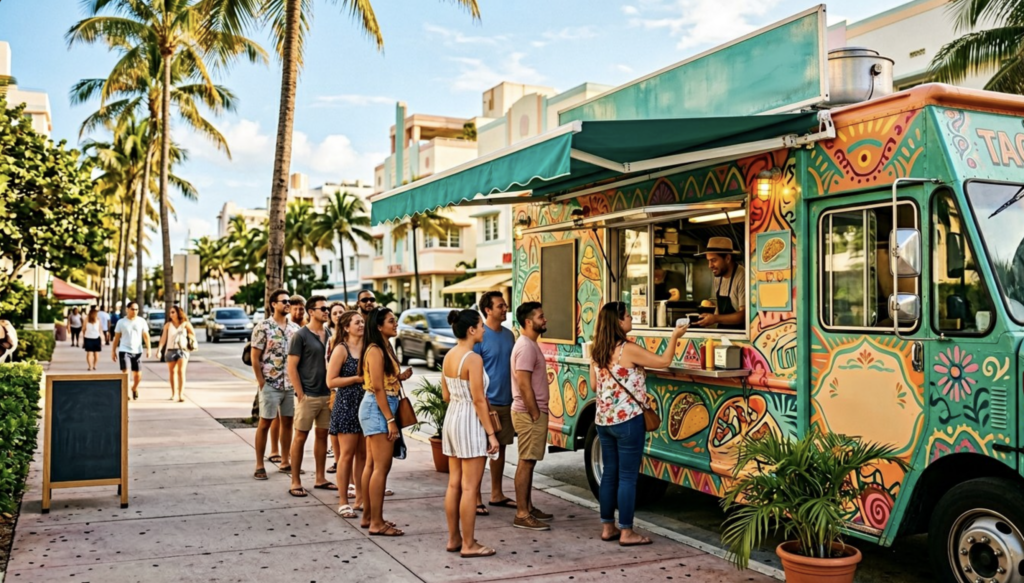
Operating a food truck in Miami-Dade County requires multiple permits, and many of them demand proof of insurance before approval. Here is what you need:
County and City Permits:
- Certificate of Use (CU) — Required from Miami-Dade County for every mobile food service operation. Renewable annually. Each operator must produce authorization from the property owner where the truck will park.
- Mobile Food Vendor Permit — Issued by the Florida Department of Business and Professional Regulation (DBPR) for trucks serving cooked or prepared food, or by the Florida Department of Agriculture and Consumer Services (FDACS) for prepackaged food items.
- Business Tax Receipt (BTR) — Required by both Miami-Dade County and the City of Miami. In the City of Miami, food trucks need a Peddler’s-type BTR.
- Health Department Certification — The Florida Department of Agriculture conducts regular inspections. You must pass before operating.
- Commissary Agreement — Most food trucks serving cooked food need a signed agreement with a licensed commercial kitchen for food prep, storage, and cleaning.
Insurance Specifically Required for Permits:
- PortMiami requires a certificate of insurance naming Miami-Dade County Risk Management as an additional insured, with minimum limits of $100,000/$300,000 liability and $50,000 property damage.
- Most event venues in Wynwood, Brickell, and Miami Beach require a Certificate of Insurance (COI) showing $1,000,000 in general liability before allowing food trucks on-site.
- The City of Miami restricts food trucks from operating within 500 feet of existing food service establishments — violating this can result in a $250 first-offense fine and $500 for subsequent offenses.
Having an independent insurance agent who can issue same-day COIs is critical for food truck operators who book events on short notice.
Common Mistakes Miami Food Truck Owners Make With Insurance
After working with food service businesses across South Florida, we see the same costly mistakes repeated by food truck owners:
1. Relying only on personal auto insurance. Your personal auto policy will not cover a commercial food truck — period. If you are in an accident while operating your food truck and only have personal auto coverage, your insurer will likely deny the claim entirely. You need a commercial auto policy specifically listing your food truck.
2. Skipping product liability coverage. Miami’s heat and humidity accelerate food spoilage. A customer who contracts food poisoning can file a lawsuit that costs tens of thousands of dollars to defend, even if you win. Product liability coverage is usually included in a good general liability policy, but always verify.
3. Underinsuring equipment. Many food truck owners insure their truck at its Blue Book value but forget about the $30,000–$80,000 in custom kitchen equipment bolted inside. Make sure your policy covers permanently attached equipment and has adequate replacement cost coverage — not just actual cash value.
4. Ignoring hurricane and flood risk. Standard commercial auto and property policies may exclude wind and flood damage. In Miami, where hurricane season is a fact of life, you need to confirm your policy covers weather-related damage or add endorsements specifically for windstorm and flood.
5. Not getting workers’ comp when it is required. Florida imposes stop-work orders and fines of $2 per day per uncovered employee (with a minimum penalty of $1,000) for businesses that fail to carry required workers’ compensation insurance. If you have four or more employees — including part-time and seasonal staff — you must have coverage.
Why SOVA Insurance for Your Miami Food Truck
SOVA Insurance is an independent agency based in South Florida, which means we are not tied to any single insurance company. We shop your food truck insurance across dozens of carriers — from national companies to specialty food service insurers — to find the best combination of coverage and price.
Here is what sets us apart for food truck owners:
- Multiple carriers, one agent — We compare policies from carriers that specialize in mobile food businesses, including those who understand the specific risks of operating in Miami-Dade County.
- Same-day COIs — When a Wynwood venue or Calle Ocho organizer needs your Certificate of Insurance by tomorrow, we deliver it fast.
- Multilingual service — Our team speaks English, Russian, and Ukrainian. Miami’s food truck scene includes entrepreneurs from around the world, and we make insurance easy to understand in your language.
- Local expertise — We know Miami-Dade permit requirements, understand the local insurance market, and can advise on endorsements specific to South Florida’s hurricane and flood risks.
- Bundling savings — If you also need personal auto, home, or other commercial coverage, bundling with one agency often unlocks multi-policy discounts.
Frequently Asked Questions
How much is food truck insurance in Miami per month?
Most Miami food truck owners pay between $170 and $335 per month for a comprehensive insurance package that includes general liability, commercial auto, and equipment coverage. The exact cost depends on your truck’s value, cooking methods, number of employees, and claims history. Workers’ compensation adds approximately $30 per employee per month in Florida.
Is food truck insurance required in Florida?
Commercial auto insurance is required by Florida law for any business-owned vehicle, including food trucks. While Florida does not have a statewide mandate for general liability insurance, most Miami-Dade municipalities and event venues require $1,000,000 per occurrence in general liability coverage before issuing permits or allowing food trucks on-site. Workers’ compensation is mandatory if you employ four or more people.
What insurance do I need to operate a food truck at PortMiami?
Food trucks operating at PortMiami must hold an active business permit and provide a certificate of insurance naming Miami-Dade County Risk Management and PortMiami as additional insureds. The minimum required coverage is $100,000/$300,000 in general liability or vehicle liability and $50,000 in property damage. Your policy must also include a schedule of vehicles with VIN numbers.
Does my food truck insurance cover hurricane damage?
Standard commercial auto policies in Florida typically cover wind damage under comprehensive coverage, but flood damage is usually excluded. Given Miami’s location in a high-risk hurricane zone, food truck owners should confirm their policy includes windstorm coverage and consider adding separate flood coverage or an endorsement. Business interruption insurance can also help replace lost income during a weather-related shutdown.
Can I get food truck insurance if I just started my business?
Yes. Many insurance carriers write policies for new food truck businesses with no prior operating history. As a new operator, you may pay slightly higher premiums until you establish a clean claims record, but an independent agent like SOVA Insurance can find carriers that specialize in startups and offer competitive rates for new food truck owners in Miami.
Get Food Truck Insurance in Miami – Free Quote
Protecting your food truck does not have to be complicated or expensive. SOVA Insurance works with multiple carriers to find the coverage Miami food truck owners actually need — without overpaying for policies that do not fit. Whether you are launching your first truck or expanding a fleet, contact us today for a free, no-obligation food truck insurance quote. Call SOVA Insurance at 954-780-6667 or request your quote online — we respond fast because we know your next event is not going to wait.